Atsushi Narimatsu
This article is the second installment of a story from before I started Ginryoku Teaware. It focuses mainly on my personal experience, and I appreciate your understanding.
Prologue: An Encounter at Dan Aroma
When I was in my twenties, a café called “Dan Aroma” opened along the route from the nearest station to my home. Filled with the aesthetics and passion of its first owner, Mr. Hisamitsu, it drew in an eccentric crowd of regulars.
Having just started working, and influenced by my parents, I loved both tea and coffee. One day, a casual remark from an older regular would dramatically change my life.
“You said you like tea, but have you ever brewed tea in a silver teapot?”
That question marked the beginning of my long relationship with silverware. Through Mr. Hisamitsu, I spoke with someone who made a living selling antiques—also a customer—and I went to a sales event being held at a department store. There, I would encounter a tea set that felt like fate.
I An Encounter with Silverware from 1910
British antique tea sets are usually ornate and showy. But what caught my eye was a piece that was surprisingly small and understated.
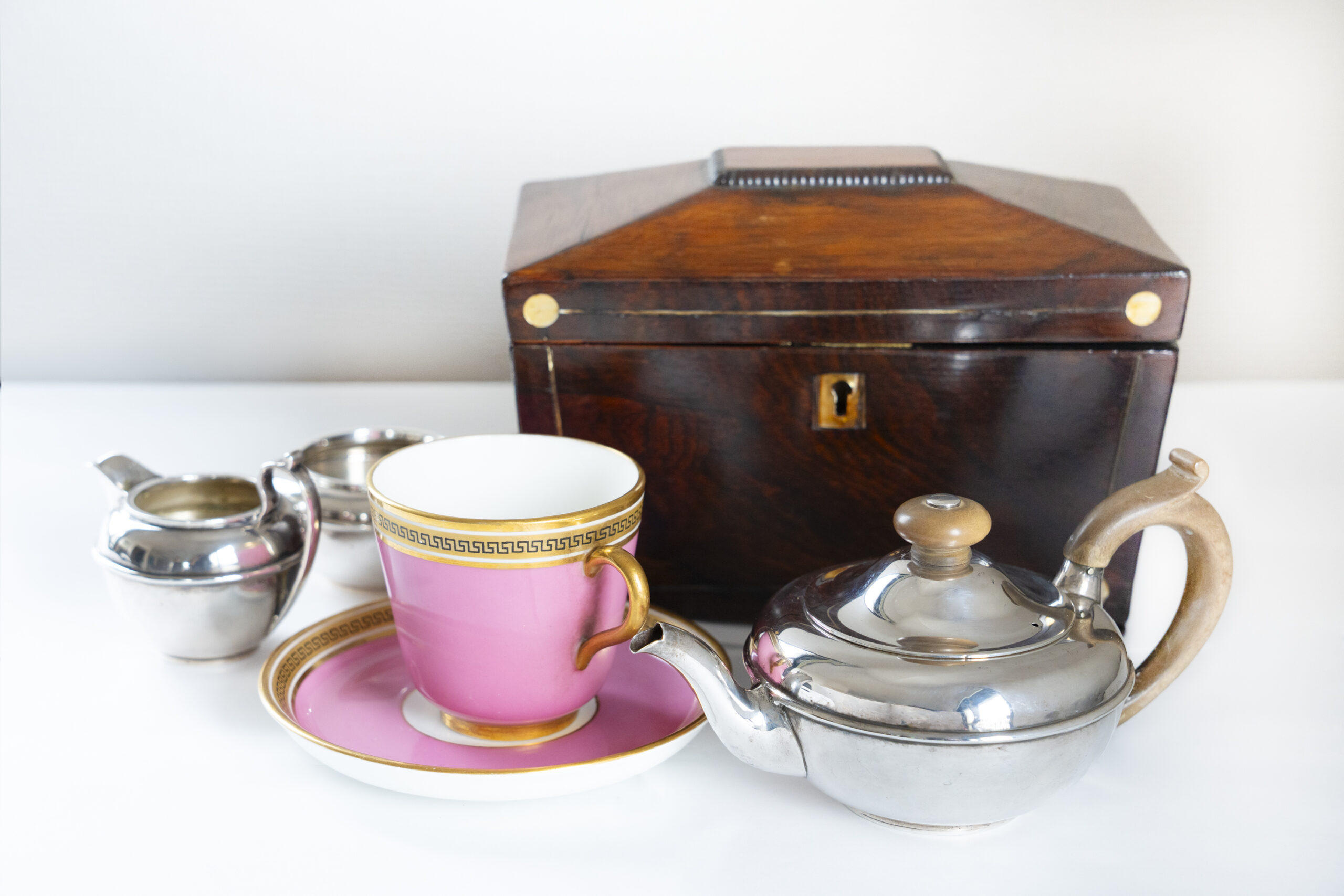
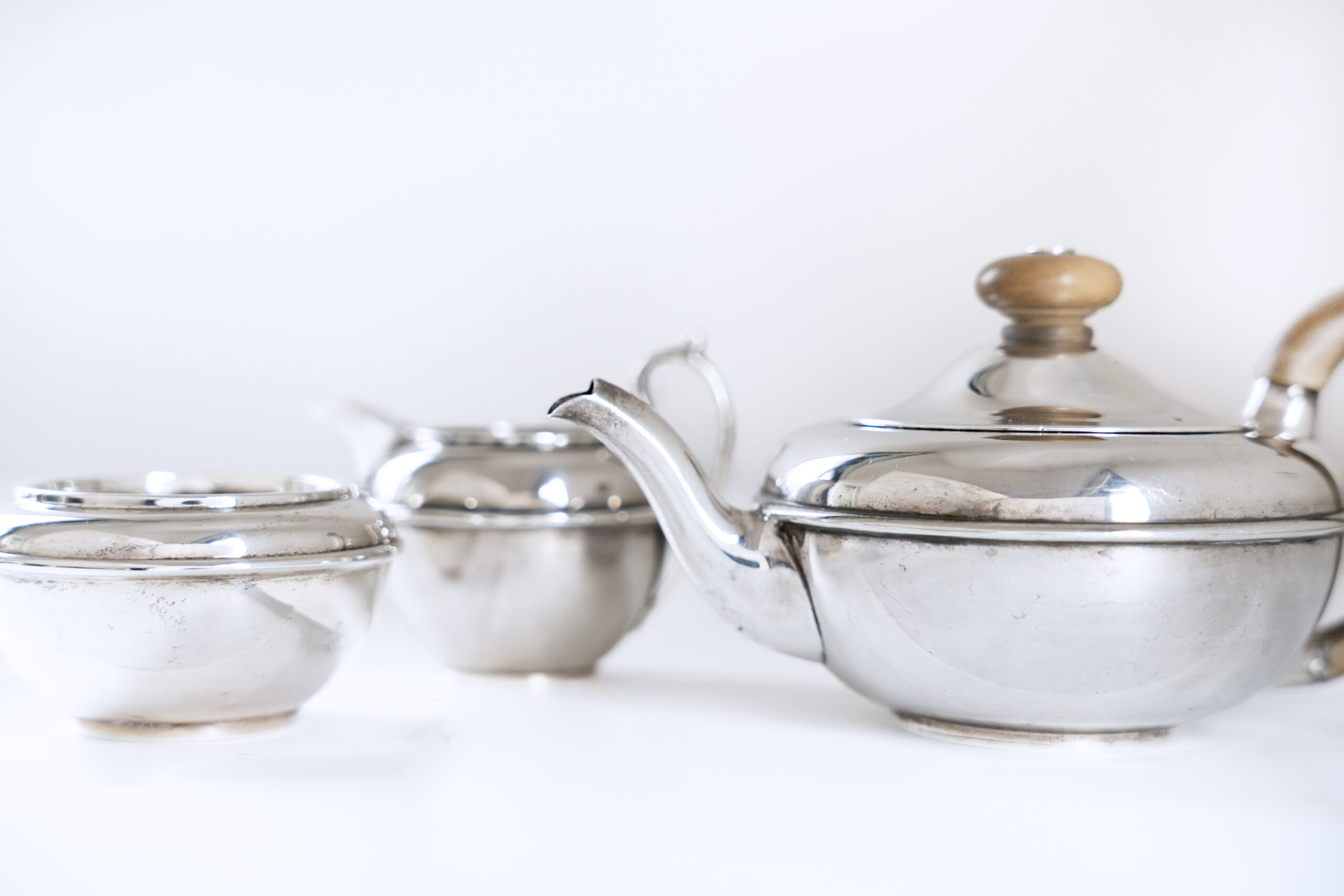
A tea set made around 1910, in 925 silver. A three-piece set—a teapot, milk jug, and sugar pot—with all hallmarks intact, making its provenance clear.
The teapot held about 300 cc—just the right size to brew two cups of tea. The polished sheen of the silver and the warmth of the wooden handle and lid formed a quiet harmony. I was captivated at first sight by its simple, honest form.
The price was about the same as a simple Rolex at the time. For me in my twenties, it was a purchase that took courage, but I had no hesitation. Only the intuition—“I can’t let this encounter slip away”—pushed me forward.
II What Aladdin’s Lamp Speaks To
Is tea brewed in silverware really that delicious? That’s what people say, but the reality is a little different. Silver conducts heat well and excels at heat retention, making it easy for the tea leaves to circulate. On the other hand, the leaching of minerals can also subtly change the taste.
In my experience, astringent teas like Darjeeling become astonishingly mellow when brewed in silverware. But more important than that was how it changed the meaning of tea time itself.
The moment I faced the silverware shining before my eyes, there was a sense of specialness you can’t get from any other teaware. For me, it was like Aladdin’s lamp—something that called forth a small kind of magic hidden within everyday life.
III Value That Keeps Shining Beyond 100 Years
Silverware quickly tarnishes if you neglect it. It needs to be polished regularly and handled with care. That very effort feels like a ritual—one that makes you face time.
This tea set has already passed 100 years. In the 30 years since I first encountered it, its form and shine have hardly changed. Everything except the wooden parts taught me the “beauty of not changing.”
Even if I could go back to that time, I’m sure I’d buy it again. The reason is simple: even 30 years later, it still creates special moments, just as it always has.
IV A Life of Keeping Doors Open
Meeting this silverware was one important “door” for me. Until then, my interest had been centered on new tea leaves and flavors, but through silverware my attention shifted to “the story of the tools themselves.”
Native American jewelry, old cutlery, and tools bearing traces of handwork—before I knew it, my life had become a journey of continuing to open doors.
I borrowed the word “door” from a line in the manga Space Brothers. “There are many doors in life. Life is made by continuing to open doors.” I believe that’s exactly right. A single tea set opened a new door in my life.
V The Potential of Craft
Treasuring things, using them with care, and repairing them when needed—keeping things “alive together for a long time.” I think true sustainability exists within that sensibility.
Materials like silver, wood, and lacquer naturally embody that philosophy. I want what supports special moments to be a “partner” to me. And I want to build a society where craftspeople who carry on such materials and techniques can continue their work in good health.
No matter how good something is, it won’t remain without an encounter. That’s why I believe providing “places for experiences” is a small way to pass culture on to the next era.
VI A Door Called Ginryoku Teaware
The concept behind Ginryoku Teaware lies in the question: “Can we transform every tea experience into something special?”
Materials, methods, and time. Each is a “door to a new world,” and at the same time a “door to a special moment.”
An earlier name candidate was “Sekiboku Teaware.” Minerals and plants, hardness and softness. Wanting to express this contrast in more open language, I combined silver and green and named it Ginryoku Teaware.
What I want to create isn’t just a tool. It’s “time” itself—time that, amid the busyness of modern life, quiets the mind and gently loosens the senses.
Epilogue: A Lifelong Companion
Each time you pick up this tea set, a quiet happiness arrives. Light reflects off the polished silver surface, and beyond the rising steam, past and present overlap.
Silverware that continues to shine for more than a hundred years taught me that “what is truly valuable continues to be loved beyond time.”
What I aim for is to create such tools together with contemporary craftspeople. The door opened by encountering a single tea set still continues to enrich my life.
And I want to quietly cultivate the new garden visible beyond that door, under the name Ginryoku Teaware.
Notes
*1 Dan Aroma: A café established near Toritsu-Daigaku Station in the 1990s. Known for its owner Mr. Hisamitsu’s distinctive aesthetics and spatial design. The café has been carefully passed down and remains in operation today.
*2 Silver 925: Sterling silver with a silver content of 92.5%. In the UK, authenticity is managed through the hallmark system.
*3 First Flush: A black-tea term referring to spring-picked new tea, such as in Darjeeling. Delicate and highly aromatic.
*4 “Space Brothers”: A manga series by Chūya Koyama. The line “There are many doors in life” is a famous quote by one of the characters.