This article is the first installment of the story of how I came to start Ginryoku Teaware. It will mainly be personal, but I hope you’ll forgive that.
I In Search of a New Adventure
Before starting Ginryoku Teaware, I had a project I worked on for nine years. It was called Muzeo*1—a site where collectors could build museums online. The number of registered collections submitted by users reached nearly one million, but with the aftereffects of COVID and no way to build a revenue model that could guarantee continuity, my turn came to an end one day.
When I handed Muzeo over and finally stopped to catch my breath, what remained was something simple: “Focus on what you’re good at,” and “Build a proper cycle of money.” They’re obvious, but if you can do those, most things work out somehow. And then there’s the importance of continuing. If you can find the place where what your heart can keep doing overlaps with what a business can keep doing, you can surely do something interesting. Things you can make money from quickly don’t last—I wanted to make something like a slow-turning drill*2 that keeps rotating and moving forward.
What I lost was most of the money I’d earned up to that point, and a bit of pride. But strangely, more than wanting to get it back, I felt an even stronger urge to look for a new journey and adventure. Where might there be a field I can throw myself into and explore again?
Among my ancestors is an educator and craftsman named Noutomi Sukejirō*3. In the Meiji period, he served as a judge for exhibits at the Philadelphia World’s Fair*4 and founded craft schools*5 in various regions. Given the historical context, it was also seen as an industry for earning foreign currency, but what also stands out is the emphasis he placed on crafts as culture. At times I feel that my current activities lie on an extension of that way of thinking.
II Why Teaware?
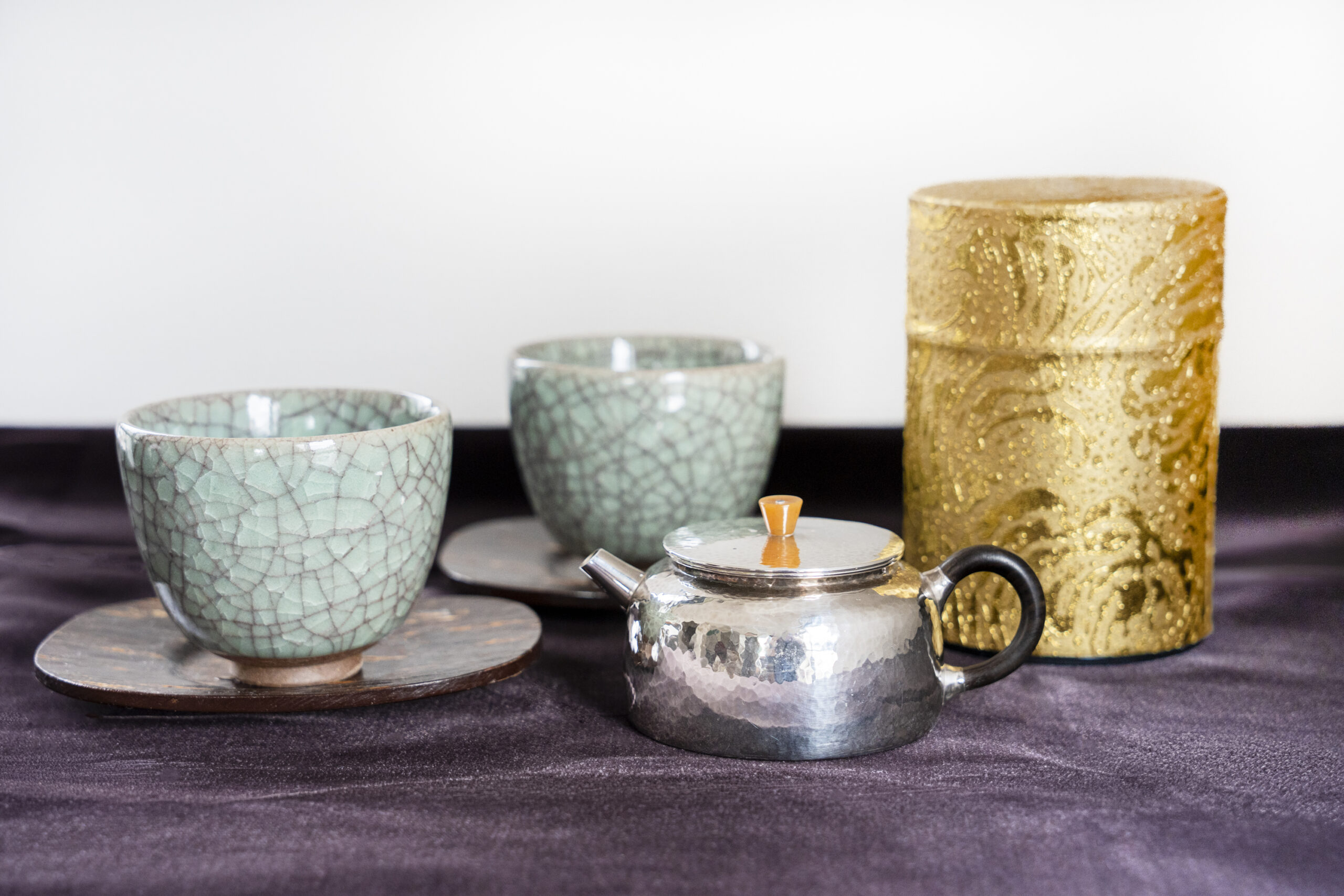
I’ve always had strong collector tendencies and have gathered all kinds of things. I own about 400 pairs of leather shoes, and I have plenty of Star Wars minifigs*6 too. But those weren’t accumulated for market value; they’ve built up as traces of my interests and explorations. Rather than collecting what’s considered “valuable,” I’ve honestly collected what I wanted. Tea utensils are one of those too—I have around 30 Chinese tea pots*7 (kyūsu) alone. Within that, wanting to create tools that would make my own tea life even more enjoyable became the starting point for Ginryoku Teaware.
The only product that truly succeeded in Muzeo Factory*8, a side project of Muzeo, was a product called Nigiri-ishi Dharma*9—something people genuinely longed for, made with reliable craftsmanship. That’s where I felt there was room left to explore. In the field of teaware, Japan has strengths in tea and in craft design, and there’s potential to aim for the world even on a small scale.
Business and my past interests lie along this same extension. The romance is in connecting with the world.
To engage with craftspeople around the world with respect, and to create something new together. I feel a quiet joy in being able to understand the world little by little through that process.
The importance of focus that I learned from Muzeo has been made concrete as a clear narrowing of both the field and the model.
III Designing the Name and Philosophy
In the period of starting over after COVID, I went to live music shows to regain various senses. I was quietly impressed by how many new bands had Japanese names*10. I thought that if we, too, were setting sail in a small way toward the world, using Japanese could be a good choice. The name of Ginryoku Teaware’s operating company, “Neuer Garten,” is German for “new garden.” The garden is a motif, with green as the theme color. And silver was a material I’d been drawn to for a long time—sometimes it even feels like a kind of talisman. As these elements naturally overlapped, the name “Ginryoku Teaware” was born.
Silver is mineral-like and hard; green is plant-like and soft. That contrast symbolizes not only materials, but existence itself: minerals and flora/fauna, change and stillness, strength and gentleness, time and life. The name “Ginryoku” holds the balance of these two poles. Also, making things from natural materials represented by green and silver leads to craftsmanship that can be carefully nurtured, and I believe that is itself a fundamental concept of environmental coexistence. And in silver, the wish to polish; in green, the wish to deepen. These two wishes are also among the thoughts embedded in the name.
IV The Times and a New Vision
At the heart of the brand concept, I place the phrase “Preserve & Evolve (protect, and evolve).”
Human beings are entities that keep changing, and that change comes with destruction.
Even so, I believe it’s possible to change while valuing history and connections.
The development of social media not only made the world feel smaller, it also expanded the spaces that connect individual expression. There are many problems, but focusing on the good, it has the power to “connect.” What draws me is not a temporary link, but connections that continue and circulate. Connecting with people around the world through shared curiosity for tea and craft, and nurturing something new over time—I feel romance in seeing such teams spread beyond borders and cultures.
This vision feels “DAO-like*11” to me. Autonomous individuals bring respect to the table and create new value while honoring each other’s backgrounds. Rather than destruction or “democratization,” I’m searching for the next form of society—one sustained by resonance and continuity.
V Beautiful Coexistence
Human beings change and move forward, sometimes destroying things along the way. Even so, if we can stay mindful of non-human beings and maintain a sensibility of “cherishing,” we should be able to sustain coexistence for a long time. Rather than systems like recycling or protection, I want to continue safeguarding “cherishing” as a sensibility—one of the things we must keep.
All of Ginryoku Teaware’s initial products will be born through co-creation with craftspeople. I think crafts and tea are among the few competitive strengths still left in Japan today. It’s not merely an economic activity—it’s also a means of cultural understanding.
Ginryoku Teaware is a small practice on that same extension,
They are quietly exploring a “form of symbiosis” that nurtures the future while respecting the past.
Notes
*1 Muuseo: A collection management and sharing platform. Launched in 2013. A web service that allows individuals to publish and share their collections as digital museums. https://muuseo.com
*2 Drill: Here, a metaphor for a tool that advances while continuously rotating. It expresses sustained, steady growth. The motif is the hot-blooded mecha anime Gurren Lagann. The series uses the spiral structure of genes and drills as themes.
*3 Noutomi Sukejirō (1844–1918): An educator and craft artist of the Meiji period. From Saga Prefecture. In addition to being involved in exhibiting Japanese crafts at international expositions such as the Philadelphia World’s Fair, he established craft schools throughout Japan.
*4 Philadelphia World’s Fair: The Centennial Exposition (1876), held in Philadelphia, Pennsylvania, to commemorate the 100th anniversary of the founding of the United States, was America’s first full-scale international exposition. Thirty-seven countries participated, exhibiting the latest industrial technologies, fine and decorative arts, agricultural products, and more. Japan also mounted its first full-scale national participation, with joint public- and private-sector exhibits, and the Meiji government positioned it as an ideal opportunity to present the image of an “enlightened Japan.” Through this exposition, Western design ideas had a major influence on Japanese crafts, design, and educational systems.
*5 Craft schools: Vocational and technical education institutions established in the Meiji period. Noutomi Sukejirō was involved in establishing the Ishikawa Prefectural Technical School (a predecessor of today’s Kanazawa College of Art), the Toyama Prefectural Craft School, the Fukui Prefectural Craft School, and others. They aimed for education that fused Western techniques with Japan’s traditional crafts.
*6 Minifig: A LEGO minifigure. Popular as a collector’s item, such as limited editions from the Star Wars series.
*7 Tea pot: A small teapot used for Chinese tea. Those made from Yixing clay known as zisha are especially prized.
*8 Muuseo Factory: A limited-edition goods production and sales venture for collectors, operated as a sub-project of Muuseo. It was characterized by original product development in collaboration with artisans.
*9 Nigiri-ishi Dharma: A hand grip developed by Muuseo Factory. Made with 925 silver, each piece was forged one by one into a shape that fits comfortably in the hand. It gained popularity as a one-of-a-kind handcrafted product by artisans and was featured on television programs, among others. Still on sale.
*10 Japanese-language names: Refers to the tendency for many Japanese bands that have drawn attention since the late 2010s—such as Official HIGE DANdism, Hitsujibungaku, and Ryokuoushoku Shakai—to adopt Japanese-language names.
*11 DAO-like: An organizational form that operates autonomously without a central administrator, drawing on the concept of a Decentralized Autonomous Organization (DAO).