This is the third of three stories that lead up to the beginnings of Ginryoku Teaware. It will continue to focus mainly on personal stories.
A Tea Room and Fragrance in Memory
My encounter with tea begins with childhood memories. My grandparents’ house, which had remained since before the war, was Western-style in its architecture, yet in one corner of the Western-style sitting room there was a small raised tea room. Since my grandmother taught tea, the space was wrapped in a mysterious atmosphere where Western and Japanese elements coexisted. Even to a child, that distinctive feeling left a deep impression, and I can still recall it vividly today.
Perhaps because she also grew up in such an environment, my mother—while loving Japanese tea—also enjoyed things like hand-milling beans and brewing drip coffee, and the beautiful gold-glowing tins of Fauchon apple tea. The milk tea made from tea leaves taken out of a Fauchon tin remains a special memory in my heart even now.
What remains most vivid as my first personal tea experience is the time, as a small child, when I made royal milk tea*1 in a small saucepan for the first time. I can’t clearly remember what prompted it, but for some reason the scene of adding tea leaves to the milk as it bubbled up in the pot is etched powerfully into my memory. The deep color of milk tea that comes from simmering is still a color I love unconditionally.
The World of Longing Opened by Literature
In the books I devoured as a child—Burnett*2’s “Little Lord Fauntleroy” and “A Little Princess,” and Tolkien*6’s “The Hobbit” and “The Lord of the Rings,” among others—there were scenes in which characters savored black tea or coffee. Those depictions may have nurtured my longing for tea time. Tea time as portrayed in stories was not merely the act of consuming a beverage; it was positioned as an important element that created a special time and space.
I believe these literary experiences had no small influence on my later attitude toward tea. Perhaps it was around this time that the idea began to take root in me that tea is not simply a matter of taste, but a cultural practice that enriches time and space.
“Two Doors” Opened in Adulthood
It was after I started working that my interest in tea changed significantly. During this period, I ended up opening two important doors.
The first was an encounter at a café called “Dan Aroma” that opened near my nearest station. There I discovered silverware, and at the same time stepped into the new world of Chinese tea. Especially memorable was my encounter with Fenghuang Dancong*3. Its gorgeousness—so different in direction from the Darjeeling*4 I had been accustomed to—shocked me into thinking, “Is this really tea?”
The second was my encounter with an online tea shop called “Kyoto Select Shop.” There I tasted black teas from various regions—Ruhuna and Darjeeling, Nilgiri—as well as Taiwanese tea. I’m not sure of the exact sequence of events, but they happened around the same period, and each became a catalyst that decisively changed my interest in tea.
A New Perspective: Single Estate
Through “Kyoto Select Shop,” I learned about the experience of drinking tea leaves grown in a specific tea garden. This was a major discovery for me. What I had vaguely thought of simply as “black tea” turned out to have completely different personalities depending on the production region, the tea garden, and even the plucking season.
Darjeeling*4 is categorized by harvest period into first, second, and autumnal flushes, and the flavors differ considerably. I began by experiencing that firsthand. Tea leaves from other regions don’t seem to have distinctions as clear as Darjeeling*4, but each has its own season of availability, and they began to add color to my tea life along with a sense of the seasons. In later years, I also learned many things about Sri Lankan tea from Aoyama Tea Factory. Sri Lankan teas are further divided into various areas within the country. Indian, Chinese, Taiwanese, and more recently Japanese black tea have also become quite widespread. Over time, little by little, this diversity has seeped into my world of tea.
A Growing Interest in Tools
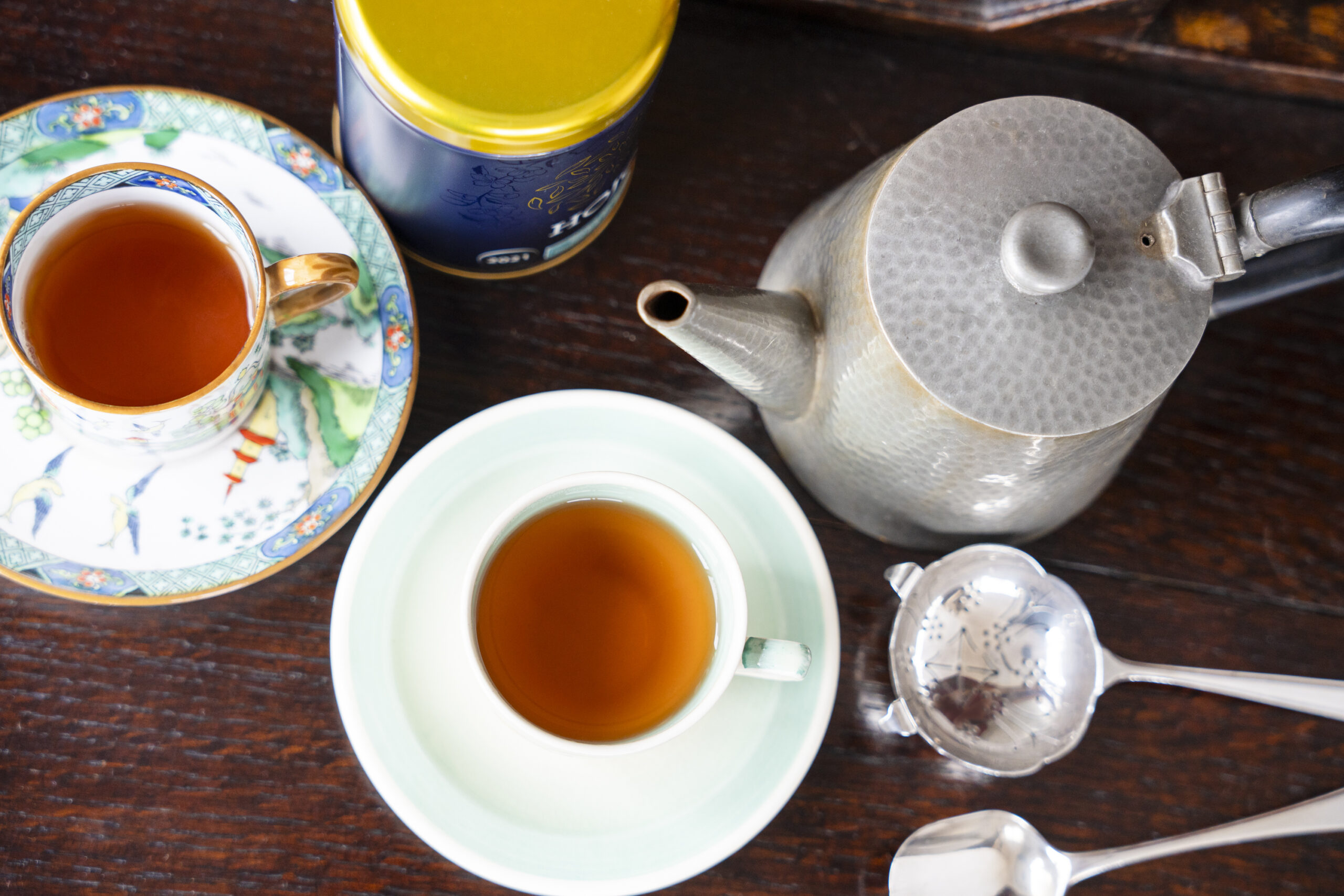
As my interest in tea deepened, my curiosity about teaware naturally expanded as well. Beginning with my first encounter with silverware, my interest spread to tea sets, tea strainers*5, and tea spoons. After I became familiar with Chinese tea, I also grew interested in teapots, and I gradually began collecting vintage teacups and the like.
That said, these tools were positioned as mediums for enjoying tea itself. Tools bring out the deliciousness of tea and make tea time richer, but that does not change the fact that tea is the main character.
Days of Ongoing Exploration
There were times when I didn’t dig very deep due to being busy with work, but my day starts with milk tea almost every day. I enjoy it while changing the tea leaves day by day—Assam, Ruhuna, and blended teas from various companies.
Even when I travel, the first thing I do is secure milk. Hunting for milk in Hong Kong is a fond memory now (whereas in the UK, it’s often left in the hotel room).
Looking back, rather than there being a single clear turning point in my “journey” with tea, it feels like various doors gradually opened little by little through continuous experiences, and my world expanded. My encounter with royal milk tea*1, discoveries through Darjeeling*4, meetings with teas from various gardens and regions, and an expansion into Chinese tea. And beyond that, an ongoing life with Japanese tea. All of these, with a sense of continuity, have deepened my understanding of tea and my affection for it.
Curiosity Opens Doors
A project I previously led called “Museo” had the concept “Curiosity opens the door to the world.” This is a truth that also applies to the world of tea. Starting with that first cup of royal milk tea*1, each curiosity opened a new door and guided me into worlds I hadn’t known before.
The richness of the tea world is not simply a matter of having variety. The unique character each tea possesses, the climate and culture of the land where it is produced, the maker’s techniques and philosophy, and the drinker’s experiences and memories—these all intertwine in complex ways and are contained within a single cup of tea.
Thoughts on Ginryoku Teaware
My current feelings toward Ginryoku Teaware lie on this same extension. What we want to offer is not merely teaware, but an entrance to new tea experiences. We hope that each piece of teaware will stir the user’s curiosity and become a catalyst for opening a door to an as-yet-unknown world of tea.
Tea is never a completed, static world. There are always discoveries, always new surprises. Regional characteristics, seasonal changes, the maker’s individuality, and the drinker’s sensibility. As all of these intersect, the experience of tea holds infinite possibilities.
A Door for the Reader
Those who have read this article surely each have their own encounter with tea as well. It may be a childhood memory, or a recent discovery. What matters is to cherish that encounter and to keep one’s curiosity alive.
The “adventure” that begins with a single cup of tea never truly ends. Encounters with new tea leaves, discoveries of new ways to brew, encounters with new teaware—each of these enriches our world of tea and adds depth to everyday life.
The door to the world of tea is always open. All that’s needed is the curiosity to try opening that door. Ginryoku Teaware hopes to explore new tea experiences together with those who have that curiosity.
My adventure, which began with a single cup of tea, is still continuing even now. And it will continue from here on out as well.
Notes
*1 Royal milk tea: A rich milk tea made by simmering tea leaves in milk. It originated in the UK but developed in its own distinctive way in Japan.
*2 Burnett: Frances Hodgson Burnett (1849–1924). An Anglo-American novelist known for children’s literature such as “Little Lord Fauntleroy,” “A Little Princess,” and “The Secret Garden.”
*3 Fenghuang Dancong: An oolong tea produced in Phoenix Mountain (Fenghuangshan), Chaozhou City, Guangdong Province, China. Made from leaves picked from individual tea trees, it is known for its gorgeous floral- and fruit-like aroma.
*4 Darjeeling: A black tea produced in the Darjeeling region of West Bengal, India. Called the “champagne of teas,” its flavor varies depending on the harvest season.
*5 Tea strainer: A straining tool used to filter tea leaves. Made with a mesh screen, it is used when pouring from a teapot.
*6 Tolkien: John Ronald Reuel Tolkien (1892–1973). A British philologist and writer, known as a master of fantasy literature for works such as “The Hobbit” and “The Lord of the Rings.”
Summary
This article describes in detail the author’s history of encounters with tea and their exploration of it, from childhood to the present. Anchored in formative experiences in the grandmother’s tearoom, influenced by the mother’s tea and coffee culture, and fueled by longings inspired by literature, a turning point came during the author’s time as a CPA through “two doors” (an experience with Chinese tea and silverware at a café, and the discovery of single-estate, garden-designated tea leaves at a select shop in Kyoto). After that, through discoveries of regional and seasonal character brought by single-estate tea leaves and a growing interest in teaware, the piece consistently traces the path leading to the author’s present feelings about Ginryoku Teaware under the theme, “Curiosity opens the door.” The article presents to readers the value of ongoing exploration and an open door to new tea experiences.